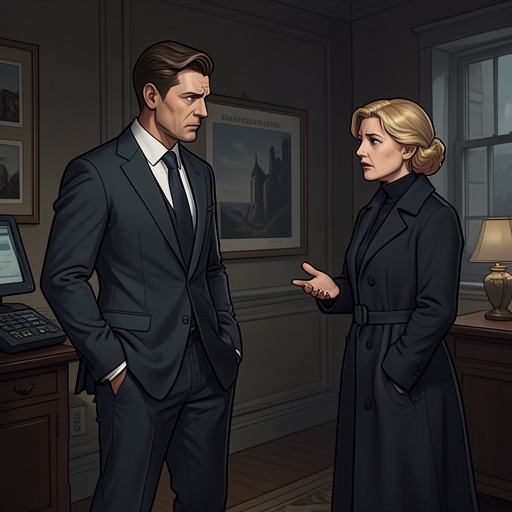
Gombet threatens Carson Drew at the Drew home
The Hidden StaircaseNathan Gombet’s confrontation with Carson Drew at the Drew home marks the change from a bitter property grievance to an open threat. Carson regards Gombet’s demand for more money as an attempt to extract an unjustified payment, while Gombet insists that the railroad took his land for too little. Nancy Drew fears that his anger may turn against her father. Gombet leaves without attacking anyone, but his warning foreshadows the more serious crime that follows: he later lures Carson to his house and holds him there while trying to force a payment.
Causes and Background
The dispute began with land condemned for a railroad right of way. Carson had served on the land commission and says he ensured that Gombet was well paid. Gombet initially seemed satisfied, but after a bridge was built he began pressing the commission for additional money, arguing that the bridge had damaged the remainder of his property. Carson considered those claims unreasonable and described Gombet as a persistent complainer.
The argument had acquired a more dangerous edge before Gombet arrived at the house. Nancy told Carson that Gombet had made threats and was said to have talked about blowing up the railroad bridge. Carson treated that report as troubling, though he doubted that Gombet would actually attempt it and said he should keep an eye on him. The possibility of violence was therefore already part of the family’s understanding of the dispute when the confrontation began.
The visit also followed a separate intrusion into Carson’s affairs. Earlier that day, Gombet had rummaged through Carson’s desk, apparently seeking the deed. Carson challenged him about the search and said that obtaining the deed would not help him. The property dispute thus reached beyond competing accounts of the railroad purchase: Gombet was trying to gain access to a document he believed could support his demand.
The Confrontation at the Drew Home
When Carson went to the front door, Nancy warned him that she believed Gombet intended to harm him and might have a gun. Carson nevertheless chose to face the visitor rather than let him snoop around the house. He opened the door, confronted Gombet, and asked what he wanted. Gombet answered that he had come for what he considered his due.
Carson told Gombet that further harassment of Nancy would lead to his being handed over to the police. Gombet replied that he wanted his rights. When Carson challenged the basis of that claim, Gombet accused him of cheating him over the land and demanded either the deed back or the price he believed the land was worth. Carson connected this demand to the earlier search of his desk and dismissed it as futile.
The exchange made the competing positions explicit. Gombet presented the demand as recovery of money owed to him; Carson treated it as an illegitimate attempt to obtain money and said that he was convinced Gombet was trying to work a graft. Carson refused to yield when Gombet began to threaten him. Gombet’s demand for payment continued, but Carson cut him off and ordered him to leave.
At the door, Gombet turned back and warned Carson that if he did not get his money, he would do something desperate. He then slammed the door and disappeared into the night. Nancy immediately feared that the warning meant he might attack the railroad bridge. Carson doubted that Gombet had the courage to carry out such an act. The scene ends with the immediate confrontation over, but with no agreement or resolution of the underlying claim.
From Threat to Extortion
The later course of events gives the warning at the house its significance. Gombet induced Carson to go to his home by trickery. When they arrived at the old stone house outside Cliffwood, Carson hurried toward the door, intent on reaching Nancy’s bedside; Gombet got ahead of him and led him through the kitchen. A servant was working there, and Gombet gave her a significant nod as he passed. Once the men had gone into the next room, she quietly locked the outside door.
That detail retrospectively changes the meaning of the earlier threat. Gombet had not simply continued to press his claim in the hope that Carson would reconsider. He had arranged to bring Carson into a place where the servant could help prevent his departure. Several days later, Carson explained that Gombet had held him there and tried to force him to sign over money. The paper on the table was an agreement requiring Carson to pay a large sum and promise not to prosecute Gombet. Gombet’s demand for money had become a scheme to obtain it through confinement and a coerced agreement.
The threat’s consequences also bring Nancy back into the conflict as an active investigator. During her nighttime approach to Gombet’s house, she saw the servant washing dishes in the kitchen, then heard her searching the cellar after apparently noticing a sound. The servant’s presence meant that Nancy could not treat the house as empty simply because Gombet was away. When the sheriff later confronted the servant, she was holding a sawed-off shotgun. Nancy questioned her after she was taken into custody and accused her of being Gombet’s partner in crime; the servant denied knowing where he was and rejected the accusation.
Evidence, Arrest, and Significance
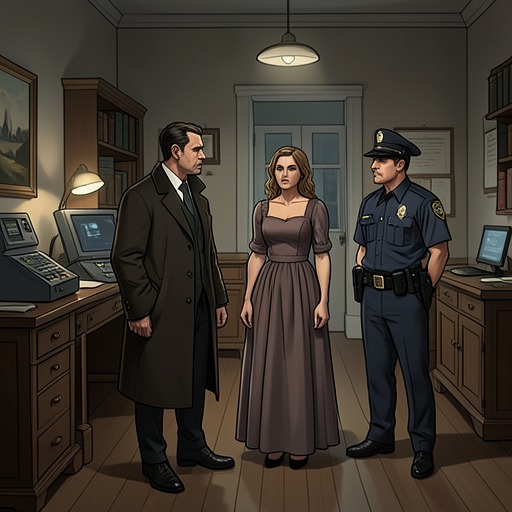
The movement from threat to arrest is not immediate. Nancy asks the sheriff to arrest Nathan Gombet and identifies him as the guilty man, while Rosemary Turnbull and Floretta Turnbull support her account of what happened at the Turnbull house. The sheriff says that he believes their story but cannot proceed without proof. In particular, he points out that finding the stolen silver urn in Gombet’s house, or obtaining comparable evidence, would give the case a firmer basis. His caution distinguishes suspicion and accusation from what he considers grounds for arrest.
The eventual discovery of Carson and the agreement supplies evidence of a different, direct crime. After Nancy gives her father water, Carson explains that Gombet tricked him into coming to the house and kept him there for several days while trying to force him to sign over money. The sheriff says Gombet has been caught in the act and examines the paper that Carson identifies as the agreement. Gombet offers no answer when Carson challenges him over the attempted payment and promise not to prosecute.
The confrontation at the Drew home therefore serves as an early, legible statement of the conflict’s terms: Gombet claims compensation, Carson rejects the claim and invokes the police, and Nancy recognizes a danger that her father initially discounts. The threat is alarming but still ambiguous in its promised form; the later confinement and agreement reveal what Gombet’s pursuit of money actually becomes. The sequence also places a legal question alongside the family danger. A disputed compensation claim is not proof of wrongdoing by Carson, and the sheriff’s insistence on evidence prevents Nancy’s certainty from standing in for a demonstrated case. The eventual paper and Carson’s account transform the conflict from an argument over land into a substantiated attempt at extortion.